

TRON: The Cyber-Underdog Of 1982 Still Shines

The summer of 1982 saw the release of many classic genre films, several of which were shrugged off at the time but are revered as classics today. For instance, this brief period saw the release of John Carpenter's remake of The Thing, Videodrome and Blade Runner: all three failed to hit big at the box office and received mixed reviews by both genre and mainstream critics. However, each film has risen in stature since then and all have achieved the level of respect they so richly deserve. Another key film from that magical summer was Tron - and it's still struggling to get the respect it deserves. Too "pop" for the hardcore genre types yet too conceptually/visually heady for the mainstream crowd, it fell into the valley of cult cinema and has nurtured a small but passionate fan base since then. Unfortunately, Tron never managed to stage the kind of retrospective comeback that other films of that era have received. It might get props for its proto-CGI visual achievements or sheepish "guilty pleasure" status acknowledgement from some fans but is mostly dismissed as an intriguing misfire. In the wake of Tron: Legacy's release, some are even reviving the jeers that greeted its original release.This state of affairs is a damn shame because Tron is oh so much better than it gets credit for being. There's more going on here than groundbreaking visual effects (though those are a big part
 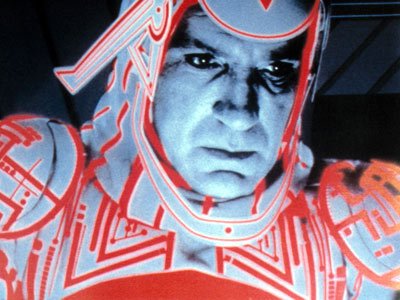 of the appeal). Simply put, Tron is the rarest of event movies, the kind that presents its spectacle with the kind of gee-whiz charm and pure-hearted joy that has all but disappeared from modern Hollywood filmmaking.The plot of Tron revolves around the activities of Encom, a computer tech company run by the ruthless, duplicitous Dillinger (David Warner). He uses his Master Control Program to run a tight ship and conceal his nefarious doings outside of official Encom business. Flynn (Jeff Bridges) is an ex-Encom employee who was ripped off by Dillinger during his rise up the corporate ladder and longs to get revenge on his nemesis. With the help of frustrated
  Encom employees Alan (Bruce Boxleitner) and Lora (Cindy Morgan), Flynn sneaks into the building to raid its main computer for evidence that will ruin Dillinger's reputation.Unfortunately for Flynn, the Master Control Program is watching and it uses a laser that can restructure living matter into digital form to transmit him into the cyber-world within Encom's banks of computers, where "programs" have the bodies and minds of people. Flynn discovers that Sark (also Warner), a cyber-doppelganger of Dillinger's, runs the world like an evil kingdom and banishes any dissenting programs into gladiator-style combat. Flynn escapes this fate by teaming up with Tron (also Boxleitner) - the doppelganger of Alan - and Ram (Dan Shor) to escape back to the human world before Sark can stop him.
 The finished film retains its charm thirty years after the fact. Tron is often rejected for being too kiddie-friendly by critics and genre types who expect a film with groundbreaker status to be a cerebral work. It instead goes the equally challenging route of making mind-blowing visuals and concepts accessible to a general audience. The use of a simple storyline is a calculated choice to allow the audience to assimilate all the computing-derived jargon and alternate reality concepts being thrown at them. The results are high on imagination but easy to comprehend, a duality that should be considered a virtue.The directness of the plotting and action give the viewer maximum leeway to groove on the visuals - and even the detractors must admit that Tron delivers handsomely in that arena. The combination of black and white photography, early computer animation and traditional optical techniques is cleverly
  applied to visual concepts designed by the likes of Syd Mead and Moebius to create a singular look. Minimalistic yet carefully designed, everything from the costumes to the ships to the landscapes have a 'neon comic-book' flair that has never really been captured elsewhere.However, a look would be nothing without an engaging narrative to fill it - and writer/director Steven Lisberger has come up with a tight, orderly storyline that threads all the eye-candy together in an appealing way. The action and the plot hooks flow in an agreeably quick style - each action setup is effectively milked for the spectacle and excitement it can offer - and the dialogue is often witty (particularly when Flynn is involved). He also populates this storyline with accessible archetypes that make it easy to get into this bizarre world: Tron is the stalwart square-jawed hero of old, Sark is the impeccably cruel villainous overlord and Flynn gives the audience someone they can relate to. Most
  importantly, Lisberger understands brevity and never allows the plot to get out of control, capturing his full storyline in 96 minutes.Lisberger also uses the relationship between the film's two worlds to make a likeably humanistic commentary on technology. As Flynn moves through the computer world and witnesses the nobility his program compatriots are capable of (as well as the evil of Sark), he - and by extension, the audience - come to realize that technology is only as good or bad as the "users" who put it into action. Thus, the film suggests we should all to look to our better qualities when exploring the cyber-realm because how we use it reflects who we are as people. This open-minded, positive approach to technology is rare and one of Tron's most special qualities.
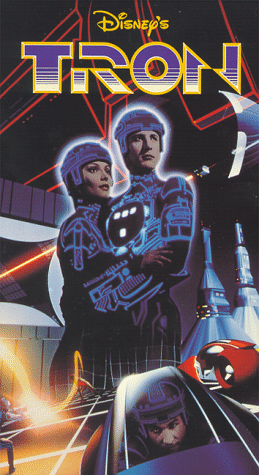 In terms of directing, Lisberger captures the film's world in a confident manner. His visual approach offsets the color and design of the production with action that is conveyed in a straightforward manner: for example, the light-cycle and disc-throwing fights are not only conceptually impressive but very well-staged and edited (directors of modern FX spectaculars should study these scenes). Capturing such a visually ambitious world in a clear, spatially coherent manner is a real achievement.As for the performances, the actors breathe life into the archetypes that Lisberger uses to give the film a human heart amidst all the technology. Bridges carries the day as Flynn, growing from a manipulative but charming rogue into a team player who realizes his forsaken qualities as a leader. His ability to play this fantasy-style material straight while bringing a wry humor to it is a key part of Tron's appeal. Warner excels with a regal turn in his dual-villain role. Boxleitner and Morgan get less to do but bring a likeable presence to their roles - Boxleitner in particular has a convincing "square-jawed hero" bearing that would serve him well in his subsequent, prolific t.v. work. Dan Shor deserves special notice for his performance as Ram, the most likeable of all the film's computer characters.
 Finally, and most importantly, Tron is the rare groundbreaking film that is lacks a self-conscious attitude about what it is doing. There are no attempts to be self-consciously somber so the audience will perceive it as "serious" nor are there any pretensions in how it lays out its story. It is fun, it is enthusiastic about its storyline and it pursues its course of action with a wide-eyed sense of wonder that is positively contagious for those who are still open enough to feel such a thing. In an era contaminated with irony and detachment, it does Your Humble Reviewer's heart and soul good to see a film like this - and Tron will always be one of 1982's genre classics in his eyes.