

THE ROOM: All Of The Badness, None Of The Passion

Mainstream showbiz does not have a monopoly on hype. Any sector of the entertainment business, big or small, can manufacture a phenomenon within its own scene if there are enough people willing to carry the torch... and the biggest hype of recent memory in cult/bad-film circles is Tommy Wiseau's The Room.A lot of nouveau-showbiz types (everyone from Kristen Bell to David Cross) have taken this cinematic crash-and-burn to heart and The Room regularly packs 'em in at Laemmle's Sunset 5 theater in Hollywood, having spawned a throng of devotees who engage in Rocky Horror/MST3K spectator-sport interaction with it. Writer/director/star Wiseau wisely avoided fighting this trend and regularly appears at these screenings, often doing a Q&A session before the film instead of after it.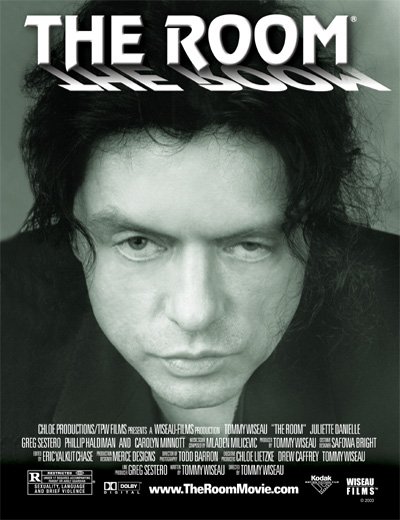 Unfortunately, The Room doesn't deliver the sort of awe-inspiring non-cinema promised by the hard sell of these partisans and their auteur-idol. Don't get Your Humble Reviewer wrong: it's bad - terrible, in fact - but it's not the kind of crazy-inspirational bad necessary to create an anti-classic. The plot is super-simple: Wiseau plays a well-meaning, philanthropic sap named Johnny who adores his bottle-blond lover and "future wife," Lisa (Juliette Danielle). Sadly, she has decided she no longer loves him and begins to fool around with his best friend, Mark (Greg Sestero). Reams of cheap melodrama ensue.In fairness to its growing cult, The Room is awful on multiple levels. The acting and dialogue continuously plumb new depths of ineptitude. There are several cringe-inducing sex scenes in which the star appears to be unfamiliar with how the missionary position works. Subplots about Lisa's mother having breast cancer and another character being in debt to a drug dealer are suddenly introduced, then abruptly dropped. The phrase "future wife" is insistently used instead of "fiancee." Wiseau reigns at the center of it all, delivering his lines in an unknown middle-European accent and emoting in a way that suggests he's never seen any sort of acting before.In short, The Room boasts flaws galore... and yet it isn't that entertaining, not even on a so-good-it's-bad level. Filmmakers reaching beyond their abilities can be entertaining but they have to do so in an inspired way to deliver a bad-movie classic. Just like a good filmmaker, bad movie auteurs need to be constantly innovating, continually topping themselves scene after scene to create the sort of giddy rush that defines beloved bad-film gems like The Apple or Massacre Mafia Style. The Room never hits those heights: instead, it establishes a dull, migraine-inducing level of badness in its early scenes and just rides on cruise-control until it reaches the end credits.Why? Because Wiseau lacks the passion necessary to make his inept art awe-inspiring. Despite his recent claims that the film is a "black comedy," Wiseau was obviously trying to make the kind of mild, middlebrow indie drama that regularly gets picked up at Sundance and shuffled through art-houses. The Room's poverty of ambition and inspiration keeps the film from ever delivering the gonzo-cinema goods. In fact, the DVD has an interview with the director that is ten times more entertaining than the film itself.Therein lies the real tragedy of The Room - it's not even good at being bad.