

SOUTH OF HEAVEN: A Festival Movie For Cult Movie People

If you spend enough time at film festivals, you quickly learn what a "festival movie" is. This description refers to a film that rarely escapes beyond the film festival circuit to find a general audience. That's mainly because the filmmakers who create such films are rarely concerned with crossover success and are more devoted to their personal aesthetic obsessions. Such films rarely cost much money yet frequently have impressive actors in the cast, because they are catnip to actors who are into their craft.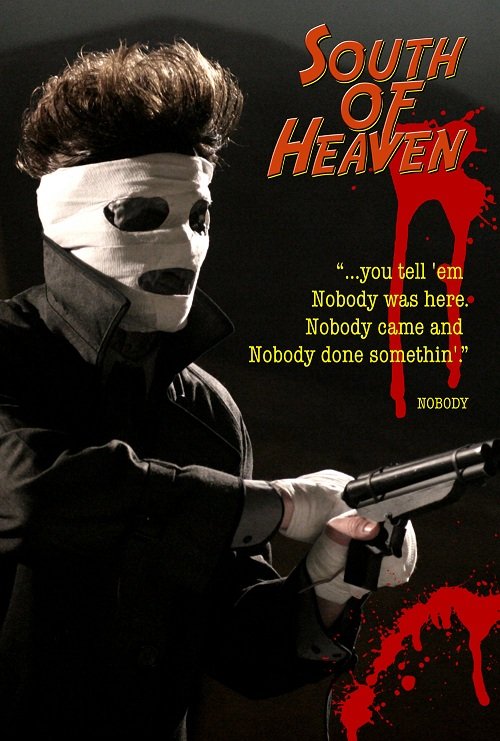 In other words, a festival movie is unconventional type of experience that puts demands on the viewer in a way a mainstream film never would. That said, such an experience can be rewarding if the viewer's interests synch up with those of the filmmaker. That brings us to South Of Heaven: it is very much a festival movie but it's the kind of festival movie that genre people can relate to because it speaks their language.The simplest way to explain the plot of South Of Heaven is to describe it as a story of two brothers in trouble. Roy Coop (Adam Nee) is a nice guy and aspiring writer who finishes a tour of duty and comes home to move in with his brother Dale (Aaron Nee). Problem one: Dale is nowhere to be found. Problem two: a pair of hoods (Jonathan Gries, Thomas Jay Ryan) show up looking for Dale, who they claim has kidnapped a wealthy hood's daughter. They're convinced that Roy is Dale and begin working him over in brutal ways to get the location of the daughter.
 Meanwhile, Dale is dealing with problems of his own. He is the terrified "partner" of Mad Dog Mantee (Shea Whigham), a quietly deranged hood who is responsible for the kidnapping. He is determined to get a ransom for the girl - and just as determined, for reasons not immediately specified, that Dale be his partner in this crime. What follows is best left to the audience to discover for themselves... but these two brothers will meet again and their reunion will be a surreal high-stakes affair.The end result is a curious but intriguing mix of styles and moods. Writer/director J.L. Vara allows his imagination to run wild but his plotting is highly disciplined, with character and story info revealed in a piecemeal way that keeps surprising viewers up the very end. It is infused with a streak
 of the absurd but it is played totally straight, no matter how wild the storyline becomes. There is a noteworthy amount of brutal violence but Vara plays it out in a sleight-of-hand manner, leaning on suggestion to get at the viewer in a way that is more psychological than visceral. The most interesting element of the film is that it uses minimalistic sets, including painted backdrops for outdoor scenes, but its photography makes bold use of primary colors and also mixes in bits of animation at key junctures.Simply put, South Of Heaven is not a film for the general audience. Its blend of pulpy crime-story archetypes, black humor, brutal violence and willful weirdness is likely to baffle the casual viewer. That said, it's
  not a difficult sell to the cult movie audience. Vara draws the narrative and visual lexicon for his film from sources like film noir, the giallo, Tex Avery cartoons and Coen Brothers-esque dark comedy.Even better, he comes up with offbeat but effective combinations of these elements, creating a stylized landscape that can be surprisingly hypnotic. The camerawork from Darren Genet is elegant (look for those 360-degree panning shots) and an unexpectedly lush musical score by Russ Howard III is elegant yet obsessive, creating a mood somewhere between Danny Elfman and Blue Velvet-era Angelo Badalamenti.Best of all, Vara plays his material straight. Despite the film's high level of stylization, the director avoids the temptation of winking at the audience in an "ain't I clever?" way. He establishes the film's oddball rules early on and sticks by them to the end.
 The same can be said for the cast. Shea Whigham gives an impressive performance as Mad Dog, creating a character that is menacing and witty by turns without ever raising his voice or going for cheap theatrics. His performance is a pure mixture of presence and commitment to his oddball role - and he just kills it in every scene. Gries and Ryan also impress as the thug duo, playing their outsize roles in a controlled manner that hits a similar combination of humor and menace.Elsewhere, Elina Lowensohn of Nadja fame dazzles as a femme fatale type who takes a curious interest in Roy's predicament - she's got a showstopping monologue at an important moment in the film that she
  nails - and a deglammed Diora Baird adds a needed note of sweetness as an ignored girlfriend who becomes Dale's love interest. That said, the core of the piece in terms of acting are the brothers Nee. They offer subtle performances that are comic and dramatic by turns, underplaying in a sly way that makes them stand out amidst the more stylized character types. Adam in particular undergoes an impressive transformation as the film progresses while Aaron shows an unusually skillful use of body language to express his character's emotions.In summation, South Of Heaven is challenging but rewarding viewing, a rare kind of "festival movie" project whose sense of eccentricity plays into the interests of the cult movie crowd. If you're up for its challenges, it delivers a memorable and worthwhile experience.