

THE HUMAN CENTIPEDE (FIRST SEQUENCE): Shock Horror Goes To The Arthouse

If you want to read some entertaining movie reviews, go back and check out the write-ups for The Human Centipede (First Sequence). This oddity tends to confound film critics accustomed to more genteel fare. The response it has gotten is a fairly even split - one half consider it a work of demented inspiration while the other half consider it a calculated upscale version of torture porn - but it's the kind of film that has everyone reaching for their thesaurus in their attempts to come to terms with its distinctively twisted story and style.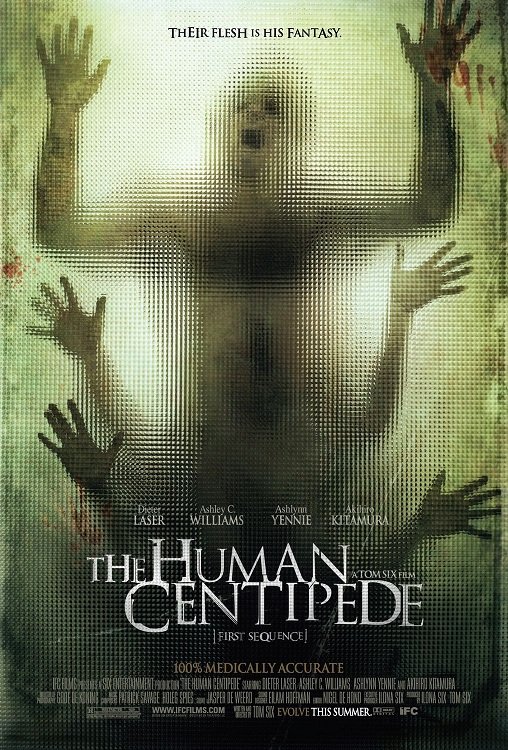 Does it live up to the hype and hysteria that it generated in critical circles? Yes, it does - and it's easy to see why it has caused such a confused, often angry response from the Daily Review Brigade. The Human Centipede (First Sequence) is an unconventional blend of arthouse austerity with grisly horror content and themes and the end result is fascinating in the darkest way imaginable.The film is set in Germany, where Lindsay (Ashley C. Williams) and Jenny (Ashlynn Yennie) are vacationing. They decide to drive to a party one night and end up with a flat tire in the middle of nowhere during a rain. They find shelter at the nearest home, only to discover the owner is a loony surgeon named Dr. Heiter (Dieter Laser). He promptly knocks them out and imprisons them in his house's surgery/experiment room.
 Once the Doctor finds another test subject in hapless Japanese tourist Katsuro (Akihiro Kitamura), he reveals to his captive audience the experiment he has planned for them. His ambition is to attach them to each othersvia their mouths and anuses so they can merge into a three-part creature with one interconnected digestive system... in other words, a "human centipede." He successfully completes his operation but that's only the beginning of the nightmare for his unfortunate test subjects.Many critics have wrongly pegged The Human Centipede (First Sequence) as a member of the "torture porn" subgenre but it's actually a novel reinvention of horror's "mad scientist" subgenre. The gruesome operation that provides the conceptual centerpiece of the story is truly inspired but writer/director Tom Six doesn't use it to prop up the whole film. Instead, the operation is only briefly shown, acting as a dividing point between the suspenseful buildup that
  defines the first half of the film and the exploration of madness and suffering that makes up its second half.Another fascinating aspect of The Human Centipede (First Sequence) is its surprisingly low-key approach to gruesome elements of its story. There is a certain amount of gore but Six is more interesting in using sordid ideas to psychologically shock his audience: in a telling touch, he gets more mileage of Laser's bloodless yet detailed description of how the operation will work - intercut with wails and outbursts of his captive audience - rather than focusing on all the gory details of the surgery.Once th
 e operation is completed, Six puts us front and center to observe the confusion and anguish of the test subjects - including a morbid/darkly funny bit in which its digestive tract is "tested" for the first time. In the process, he manages to pull off an interesting trick with audience identification. Initally, the doctor is the most interesting/compelling of the characters, with his subjects falling into conventional character types. However, once we are forced to witness their suffering in his experiment, the test subjects become more dimensionalized through the expression of their physical/mental pain - and thus more sympathetic.The performances are very important in pulling off this shift in perception. Laser has been widely praised for his performance as the Doctor and justly so - he looks like an unholy fusion of Christopher Walken and Udo Kier. Better yet, he lives up to the promise of that combination, veering between arch, deadpan black humor and freakish intensity as he fully externalizes his character's twisted nature.
 However, the test subjects also deserve praise: the physical acting that Williams, Yennie and Kitamura do conveys a range of intense emotions with economy and impact. Kitamura is the only one who gets to speak post-operation and he does well, including what is perhaps the film's most emotionally affecting moment where he reflects on his predicament in a way that is philosophical, darkly funny and horribly moving all at once.Finally, and most importantly, Six's direction is unusually disciplined (and sometimes oddly beautiful) for a film with such unsavory subject matter. His approach to visuals is both elegant and austere, often using careful composition and a minimalistic approach of color to create painterly backdrops for the story's mayhem. He doesn't flinch from violence when it arises, particularly during the over-the-top finale, but he also doesn't rely on it to make his film work. His direction shows he understands the psychological response is as important in conveying horror as the visceral one - and he deploys both with a sinister
  sense of élan.Simply put, The Human Centipede (First Sequence) is the rare modern horror film that is aesthetically well-realized as it is conceptually unnerving. Six is definitely a talent to watch and it will be interesting to see how he twists schlock and arthouse conceits together the next time around.