

HARRY BROWN: The Vigilante Genre Grows Older, Wiser & More Artful

One of the most controversial films to be released in England last year was Harry Brown. It has been roundly attacked for being a revenge fantasy a la Death Wish or propaganda for vigilantism. Even those who like it are frequently writing it off as a guilty pleasure livened up by the presence of Michael Caine. This is a shame because the film is an intelligent and thoughtful piece of work and not the quickie action-flick riff that some reviewers are carelessly portraying it as. It takes a less than reputable genre and uses its elements to create a superior, unexpectedly thoughtful version of the form that offers catharsis to its audience in a smart, dramatically rich style. As Harry Brown begins, its title character is a man waiting to die. His wife lies terminally ill in a hospital and he spends most of his time at home in a council flat overrun by juvenile delinquents who must be avoided at all costs (a harrowing P.O.V. pre-titles sequence shows what happens to those who get in the way). His one joy is going to the pub to play chess with his old friend Leonard (David Bradley). Unfortunately, this sad situation takes a turn for the tragic when Leonard, who has become a target of abuse for the local hooligans, tries to fight back and gets killed.
 Well-meaning Inspector Frampton (Emily Mortimer) unwittingly takes things to the next level when she tells Harry the killers will most likely get off with a manslaughter charge because Leonard attacked first. Unable to bear the injustice and tired of living in fear, Harry decides to find and kill the murderers responsible for his friends death. He's a worthy adversary because he has military training to draw on (veiled references are made to a stint spent fighting in Northern Ireland) but he also to deal with the limitations of his age and health. Meanwhile, an out-of-touch police chief (Iain Glen) plots a drug raid on the building that will have grim consequences for all involved.
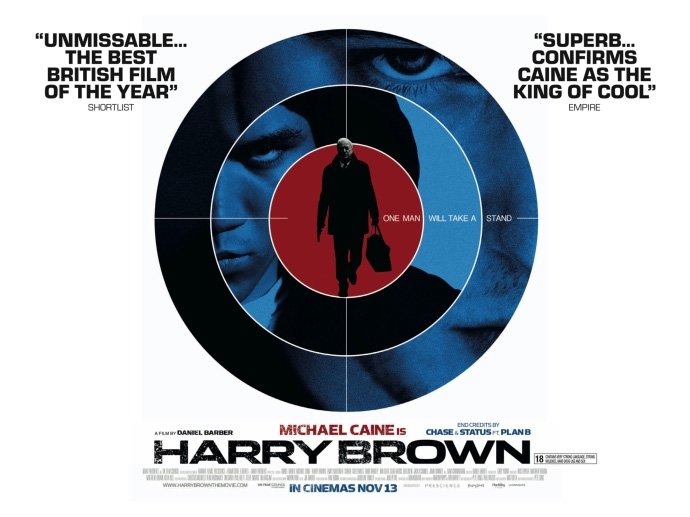 This might sound like a run-of-the-mill action flick but Harry Brown plays it as a drama. Screenwriter Gary Young sticks close to the vigilante genre's archetypal story beats but his script treats the viewer like a grownup, laying out bits of backstory and character info with subtlety and allowing us to plug them into our perceptions of what we are watching. Our main character is revealed to us in pieces, with each piece adding further dimension to our perception of him.More importantly, You
 ng avoids gratuitous shock effects and cheap melodrama in favor of a nice slow-burn approach that draws the viewer in. He also adds little character moments where you wouldn't expect them, like an interrogation montage that actually dimensionalizes the criminals by giving us brief glimpses into their respective pasts. Most interestingly, his script serves up a few moments that suggests that our youthful villains, dangerous as they are, are really victims of a societal strata dominated by even more predatory adult authority figures.
 Harry Brown is also directed with great skill by Daniel Barber, who utilizes a restrained directorial style to map out the gradually-increasing intensity of the storyline. He handles the action in an understated style that allows the brutality of the violence to speak for itself and shows more concern for the conflicts that lead up to those moments instead of flashy, bombastic setpieces. When he does throw out the stops - mainly, in the depiction of a riot near the film's end - his approach to capturing the visuals is methodical and artful. The somber moo
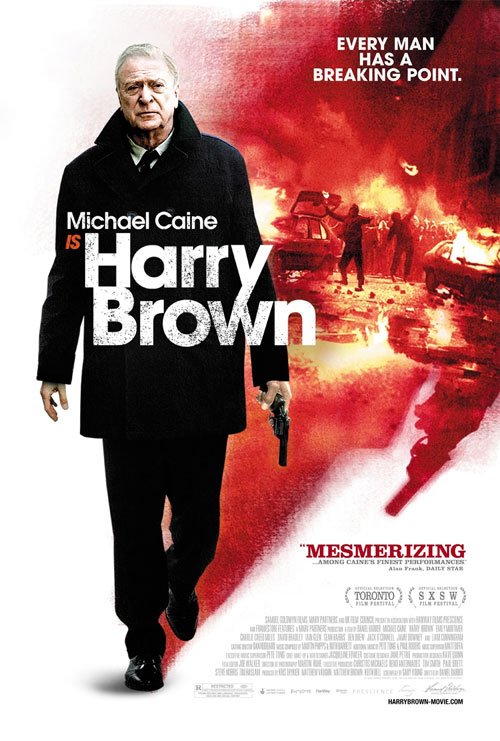 d he creates in aided nicely by Martin Ruhe's cinematography, which uses a muted, industrial color palette but carefully applies light and shade to achieve rich compositions within it.Finally, Barber gets strong - and surprisingly subtle - performances from a well-chosen cast. As you might expect, Michael Caine is the film's beating heart. He could have pulled off this role on gravitas alone but this is no paycheck gig for Caine. He gives the role of Harry Brown a deft, artfully shaded performance as he shows his character drawing on a long-repressed dark side to deal with extreme adversity. He carefully avoids going over the top, ensuring that the moments where he shows anger or reveals his capability for cool violence really pack a punch.The backing cast is similarly strong. Mortimer has been written off by many critics because she gets little to do - but that's the point of her character: she's hemmed in by a faulty system that is easily manipulated by the power-hungry. Mortimer gives a quiet but detailed performance, creating a strong yet self-con
 trolled character who carefully plays things close to the vest. Elsewhere, Ben Drew creates a convincing portrait of a thoroughly detached sociopath as the teen gang's leader and Bradley scores a few heartbreaking moments as Harry's frightened, desperate friend. However, the scene stealer among the supporting performers is Sean Harris, who chills the blood as a drug-addled, unpredictable crook that Harry buys a gun from. It's the scariest performance Your Humble Reviewer has seen in a while.To sum up, Harry Brown might cover familiar territory but it does so such artfulness and intelligence that it transcends its humble origins. It's the next level of evolution for the vigilante film. As such, it's necessary viewing for genre fans.