

FASTER: Bringing "Tough Guy" Back To The Multiplex

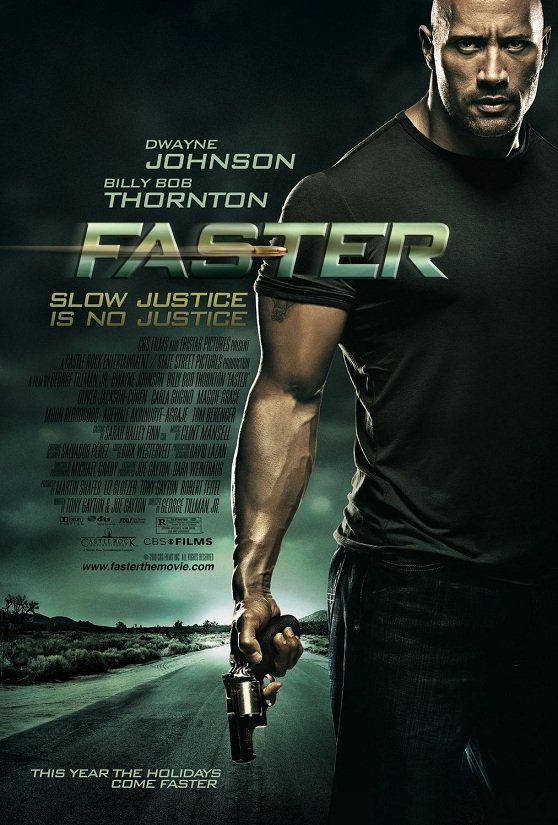
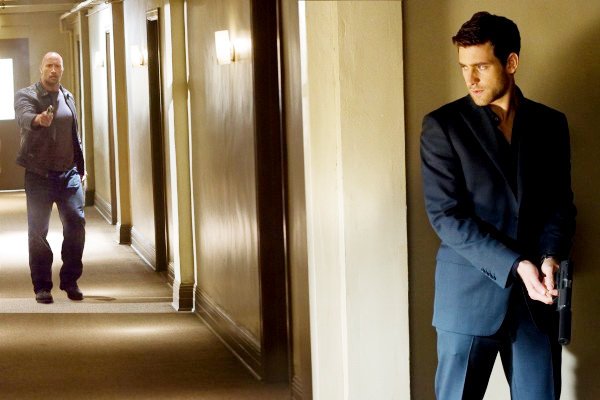
The trailers for Faster don't do this film many favors. First off, they make it look more like a car chase movie than an action movie (Your Humble Reviewer initially feared that it might be a continuation of The Fast And The Furious franchise). They also make the film seem like it is simply a vehicle for Dwayne "The Rock" Johnson, with Billy Bob Thornton thrown in as window-dressing for what looks to be a simple one-hero story. This is a shame because the film is much more interesting - and uncompromising - than these previews make it seem.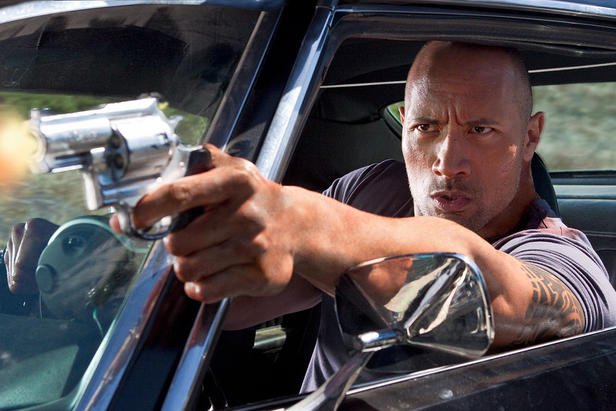 As the previews indicate, Johnson plays the character who kick-starts the film's story: he's the tersely-named Driver, a former wheel-man who is being released from prison as the film opens. He immediately grabs a car and returns home to begin a mission of vengeance, methodically killing off the people who murdered his half-brother after a heist gone bad. Seems simple enough, right?Wrong - the actions of Driver only account for one-third of the plot. Another section of the film is dedicated to the travails of Cop (Thornton), a grizzled detective who's trying to put his marriage back together as he waits out the days until his retirement. He's put on the Driver case and becomes fixated on it as he sizes up the shambles his life has become. The remaining third of the plot focuses on Killer (Oliver Jackson-Cohen), an assassin who
 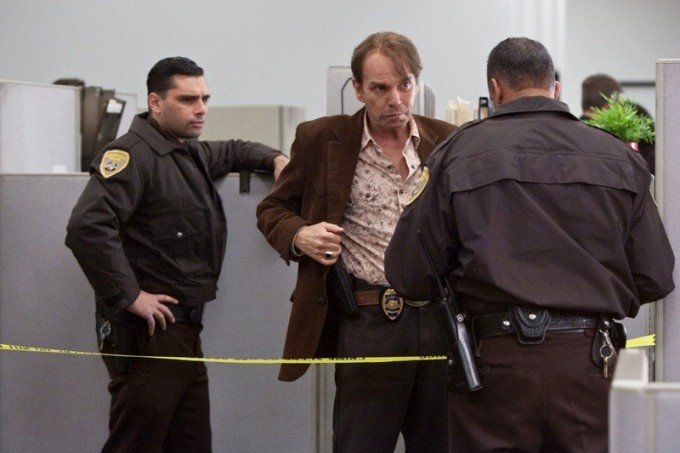 has been hired by an unknown party to kill Driver. He's losing interest in his day job because he has become serious about a romantic relationship. However, he feels compelled to finish the job.The end result delivers plenty of action - in fact, the opening sequences offer more excitement in six or eight minutes than most modern thrillers offer in their entire running time - but the script has more on its mind than pulp thrills. It owes a certain debt to Kill Bill in its initial setup but moves into more interesting territory as it explores the inner lives of its three leads. The archetypal characters and plotting conceits are used to create a meditation on revenge, its costs and how the all-consuming obsession it breeds can cost the avengers and the people in their lives.
 The acting is appropriately stylized to fit the existential-pulp nature of the narrative. Driver is written as an empty shell of a man driven only by his need for revenge so Johnson appropriately plays his as a force of nature who is more scary than sympathetic. That said, he allows him to have the occasional glimmer of humanity and does a good job of showing how Driver struggles with his mission in its latter phase. Thornton is in familiar burn-out territory as Cop and he fits the role nicely, delivering a lived-in portrait of debauched weariness that instantly convinces. Killer is the most cartoonish of the characters in conception but Jackson-Cohen plays him with a fierce, single minded energy that makes it work.Female characters mostly live on the margins of this macho world but Carla Gugino has some fun banter with Thornton and Jennifer Carpenter delivers a nice, emotional cameo as the only woman on Driver's list. That said, the big scene-stealer amongst the supporting cast is former Oz regular Adewale Akinnuoye-Agbaje as a crime conspirator who has attempted to atone for his pa
 st by becoming a preacher. A scene he and Johnson share near the end of the film is Faster's dramatic highlight.However, the key element necessary to make a film like Faster work is the direction - and thankfully director George Tillman Jr. is up to the task. He keys into the minimalism of the script and goes for a stylish yet stark approach. He combines an arid visual style with muscular pacing and resists the temptation to overdo the action scenes with too many angles and MTV editing. Instead, the action is delivered in short, intensely focused bursts that hit hard thanks to their precise calibration (a car chase flashback in the middle of the story is particularly dazzling, as is a mano-a-mano knife fight in an enclose
 d space). The end results have a visceral intensity. Most importantly, he draws out the humanity in the script while never shying away from its grimmer elements.In short, Faster is a surprisingly strong throwback to the glory days of tough-guy cinema: specifically, the 1970's variety that sought to offset its pyrotechnics with well-acted explorations of macho themes. It deserves credit for going this old-school route at a time when it would be easier to make another toothless, glossy thriller.