

THE BOOK OF ELI: Go (Spaghetti) West, My Post-Apocalyptic Son

There's a lot of talk going around about the religious angles of The Book Of Eli. Fanboys and critics are arguing if it takes these angles far enough, if it's just a cheap add-on to spice up an action flick and whether or not the film can justify this content. Rest assured, there is plenty to be discussed and Your Humble Reviewer will cover it.But first, the plot must be addressed. Eli (Denzel Washington) is a loner roaming his way across post-apocalypse America. In his possession is a book that he will let no one see. He considers it his mission to take the book out west. Unfortunately, he stops for supplies in a small town belonging to Carnegie (Gary Oldman). This man rules his townspeople through fear and intimidation as he plots to build an empire from the ashes - and it just so happens that he covets the book in Eli's possession. Thus, the stage is set for a battle of wills, much bloodshed and a whole lotta religious symbolism.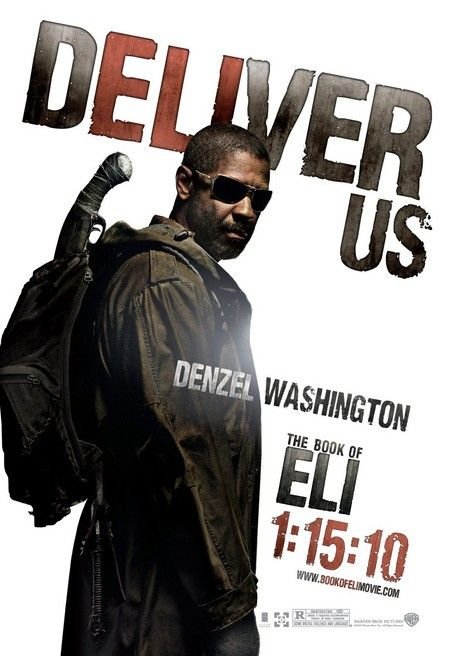 Brace yourself for a minor spoiler: in case you couldn't guess, the book the plot revolves around is a Bible. Eli wants to protect it until it can be delivered to its destiny while Carnegie wishes to have it so he can have the proper "words" needed to control the hearts and minds of his budding empire. The use of a Bible is a brave choice on the part of writer Gary Whitta because it opens the film up to many attacks: some will write the film off as a commercial for Christianity, some religious zealots will miss the finer points of the film's message as they fixate on the use of the Bible, etc.All this Bible talk unfortunately obscures the film's real agenda. The Book Of Eli is a meditation on the concept of faith: why it is important, the costs that come with it, how it can be manipulated in the wrong hands and how it can blind the people who have it from seeing what is in front of them. In this context, the use of the Bible makes perfect sense because it is an instantly recognizable symbol - both of faith itself and of how it can be misinterpreted (willfully or honestly).Of course, such messages mean little if they lack a good vehicle to push them forward. Thankfully, The Book Of Eli has been directed with great élan by The Hughes Brothers. They handle the bone-crunching action scenes with confidence and use multiple techniques to give each its own character: one battle between Eli and a gang of marauders is handled in a single, dazzling backlit shot while an epic shootout near the end makes effective use of carefully-timed camera moves to sell its chaos (including a great shot where the camera goes directly towards the barrel of a firing Gatling gun).
 However, The Book Of Eli isn't all flash and fury. The Hughes Brothers also get fine performances to flesh out the contours of their allegorical tale. Washington gives a focused, tightly controlled performance as the cautious hero while Gary Oldman uses a mix of oily charm and scarily single-minded anger to breathe life into his sleazoid entrepreneur archetype. Mila Kunis has less to do as the unwanted sidekick Eli picks up but she gives the role the proper ingenue innocence needed. The real surprise in terms of acting is a gem of a support performance from Jennifer Beals: she has only a few scenes as Carnegie's 'kept woman' but gives them a richly emotional quality, one achieved mostly through carefully-deployed and controlled facial expressions.The Hughes Brothers also have fun with the script's genre-bending elements. For example, they get in the appropriate post-apocalyptic visuals (including a blink-&-miss-it reference to A Boy And His Dog). However, the neatest thing about The Book Of Eli from this standpoint is that it is essentially a spaghetti western: a stranger on a silent mission comes to town, is derailed by a corrupt town boss and forced to fight countless henchmen to restore order and continue his journey. The directors play this angle up in a big way, giving it the same haunted, dusty feel spag-western fans associate with Django or Keoma (complete with occasional touches of eccentric gallows humor).
 These genre elements bother some critics. Some are even saying it's hypocritical to deal with religious themes in a violent action film. To these eyes, such attacks miss the point because this is how the language of genre works: it shakes the audience up with a visceral approach, using familiar storytelling concepts to get instant access to the viewer's subconscious, and then lets the ideas carried by these iconic elements sink in. The Book Of Eli mixes the kinetic and the symbolic to get the viewer's mental wheels turning. It's not meant to give you a finalized, easily digestible message. Instead, it asks you to ponder these ideas and your relationship with them.That's a gutsy move for a Hollywood flick to make - and it makes The Book Of Eli a worthy addition to the post-apoc cinema canon.