

DRACULA (1979 version): Less Blood, More Romance, Fangs Optional

In this post-Interview With A Vampire/post-Twilight era, it's hard to believe that there was a time when it was a controversial move to make a Dracula movie that presented its anti-hero as a figure of seduction rather than a figure of terror. However, this was true in the late 1970's: you were expected to deliver a customary amount of blood, thunder and gnashing vampire fangs, unless you were making a comedy-horror film like Love At First Bite. Any film that dared not follow this mandate ran the risk of alienating horror fans and confusing non-horror fans.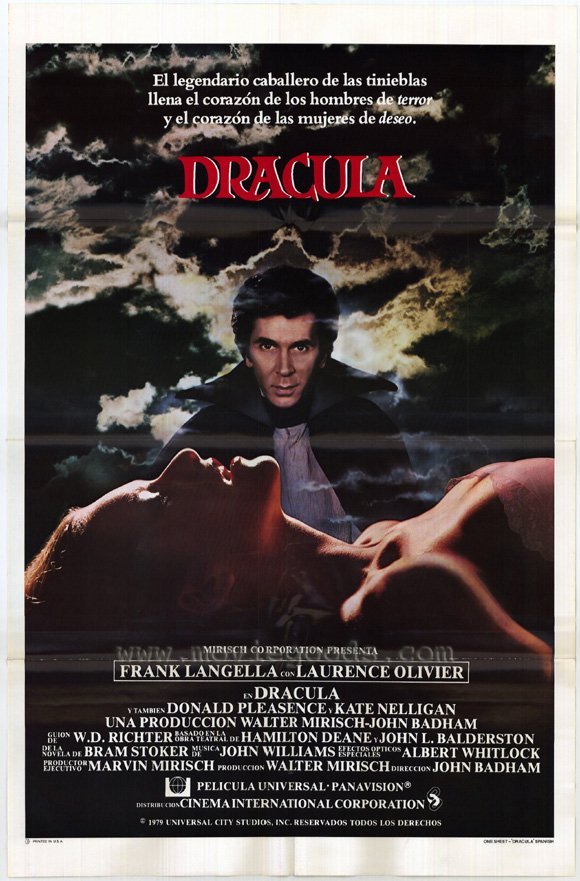 And that brings us to the least respected adaptation of this classic tale, the 1979 version of Dracula. Genre fans got their collective panties in a knot over it because a) it favored a more romantic approach - complete with a 'sexy,' quasi-sympathetic Dracula - instead of the usual gruesome hijinks and b) it was directed by John Badham, who had just come off a zeitgeist-tapping, very non-horror hit called Saturday Night Fever. The film did middling business at the box office and has been consigned to home video oblivion since then. So it is the misguided bomb some perceive it to be or a classic waiting to be rediscovered?Truth be told, it exists somewhere in the middle space between those two judgments. Dracula falls short of being a classic because its experimental approach to the tale isn't as fully realized as it could have been. It is based on the Broadway play version of the story rather than drawing directly from the
  Bram Stoker novel, favoring the romanticized take on the story that became a big Broadway hit in the late 1970's. As adapted for the screen by W.D. Richter, it racks up several further changes - dropping some scenes altogether, expanding others and adding some new tweaks all its own.Some of the choices are effective - making Lucy a model of proto-feminist independence and moving things to an Edwardian setting are the most potent. However, other changes could have used a bit more thought: a sudden car-vs.-horse carriage chase near the end seems to have walked in from a different movie. Also, some of the casting doesn't work -
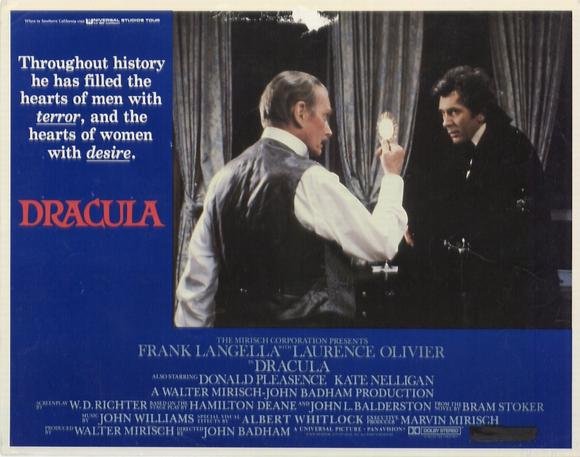
  Trevor Eve provides one of the more bland interpretations of Jonathan Harker. More importantly, the third act blurs by in a hasty and disjointed style, lacking the smooth, dramatic build necessary for this kind of gothic effort.However, that doesn't mean this Dracula isn't worth watching. The film is stylish and committed enterprise, managing to entertain even when some of its choices fail to connect with the viewer. First and foremost, Frank Langella is a top-flight Dracula, making him as lusty as he is imposing to create one of the more seductive takes on this familiar character. A young Kate Nelligan adds some fire as the re-imagined Lucy character and Laurence Oliver is hammy in the best possible way as Van Helsing - his scenes with Langella crackle with intensity.
 Best of all, the underrated John Badham directs with confidence and great cinematic flair. Utilizing sumptuous scope photography from Gil Taylor and one of John Williams' best (and most atypical) scores, he gives the film a grand, old-fashioned atmosphere of dark romance. He also creates one of the most unusual and memorable vampiric seduction scenes - this moment goes heavy on the optical effects and is too over-the-top for some but its electrifying to Your Humble Reviewer's eyes. Finally, you gotta love those gorgeous matte paintings by Alfred Whitlock (they still look better than CGI).In short, this isn't the best Dracula out there - mainly because it forsakes its horror roots to be a gothic romance. That said, modern viewers accustomed to romanticized vampire-lite fare might find this trailblazer to be worthwhile gothic eye-candy.